


News & Announcements

Nova Scotia Building Code Regulations: Public Notice
- Details
- Category: News & Announcements
Nova Scotia Building Code Regulations: Public Notice
The Government of Nova Scotia is considering amendments to the Nova Scotia Building Code Regulations. Nova Scotians are invited to provide feedback on the proposed changes by 29 September 2023.
The proposed amendments to the Nova Scotia Building Code Regulations are required to adopt the 2020 National Building Code, National Plumbing Code and National Energy Code for Buildings as the minimum standards for construction in the province.
The amendments are proposed to come into effect on or after 1 January 2024.
How to participate
Nova Scotians are invited to review the proposed amendments and provide their feedback. The deadline for submitting your comments is 29 September 2023.
Review the Nova Scotia Building Code Proposed Regulations (PDF) and Draft Amendments Schedule A to C (PDF) before sending your comments.
You can submit your comments by email or mail.
Joe Rogers
Building Code Coordinator
PO Box 231
Halifax Central
Halifax, Nova Scotia, B3J 2M4
For Questions or more information
Phone: 902-424-5721
Toll-free (within Nova Scotia): 1-800-559-3473
* The document can also be viewed at the Municipal Administration Office during regular office hours.
Check in at the front desk. The document will be located in Council Chambers along with contact numbers if you have questions.
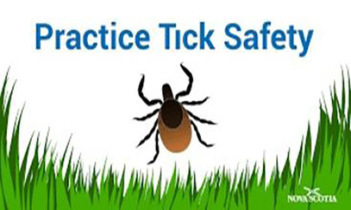
Enjoy the outdoors – and be tick aware!
- Details
- Category: News & Announcements

Enjoy the outdoors – and be tick aware!
Message from:
Dr. Jesse Kancir, MD MPhil CCFP FRCPC
Regional Medical Officer of Health, Eastern Zone
Public Health, Nova Scotia Health
Summer and fall in Nova Scotia are wonderful seasons where people spend countless hours outdoors at the many beautiful beaches, trails, parks, and wooded areas across our province. As we take in these natural riches we should also be mindful of the presence of ticks. These small insects – sometimes as small as the period at the end of this sentence – are found across Nova Scotia and can cause tick-borne diseases, including Lyme disease and anaplasmosis.
Here are some steps that people can take to protect themselves, especially in grassy, wooded, or shrub-covered areas:
• Apply insect repellents containing DEET or Icaridin to exposed skin and clothes. Follow directions on the package carefully. Infants under the age of six months should not use these products.
Please visit Personal Insect repellents - Canada.ca for specific instructions.
• Wear light colored, long-sleeved shirts and pants, closed-toed shoes, and tuck shirts into pants and pant legs into socks.
• Keep lawns mowed short.
• Put playground equipment in sunny, dry places away from wooded areas, yard edges, and trees.
• Check your whole body for ticks when possible (especially armpits, ears, knees, hair, groin) and take a bath or shower within two hours of coming indoors. This makes it easier to find ticks and washes away loose ones.
What do I do if I find a tick on me/my child?
If you find a tick on your body, remove it as soon as possible to lessen the risks of infection. Here’s how to remove them safely:
• Carefully grasp the tick with tweezers as close to the skin as possible.
• Gently and slowly pull the tick straight out. Don’t jerk, twist or squeeze it.
• Clean and disinfect the site with soap and water, rubbing alcohol or hydrogen peroxide.
• Dispose of the tick in a sealed plastic bag and put in the garbage.
• Do NOT burn, squeeze, or coax a tick’s mouthparts from your skin using other methods.
eTick.ca is a free service that can identify the type of tick usually within 24 hours. Though Lyme and other tick-borne diseases in Nova Scotia are transmitted by the blacklegged (deer) tick, not all black-legged ticks carry disease and not all blacklegged ticks have black legs.
Blacklegged ticks that are attached to someone’s skin for at least 36-48 hours pose the highest risk of transmitting the bacteria that cause Lyme disease. One of the earliest and most common symptoms of Lyme disease is a rash that’s often shaped like a bull's-eye that occurs on the same site as the bite. Other symptoms of Lyme disease may include fever, fatigue, muscle aches, joint pain, headaches and occasionally irregular heartbeat, facial paralysis, weakness, confusion, and seizures. Symptoms of other tick-borne diseases can include those listed above for Lyme disease, as well as abdominal pain, vomiting, and/or jaundice. If you’ve been exploring outdoors, especially in wooded areas, forests, areas where tall grasses and/or shrubs are present, or have found a tick on your body, and show these symptoms, see a healthcare provider. Symptoms for tick-borne diseases typically appear within a few days to up to five weeks after you have been bitten.
There is no vaccine for tick borne diseases in Canada, however, there are antibiotics for the tick-borne diseases that are known to be in Nova Scotia. If a tick has been attached and is swollen (has been attached for more than 36 hours) you may be eligible for antibiotics to prevent an infection. You can visit a pharmacist, or a physician or nurse practitioner, to see if you need antibiotics.
For more information on tick-borne diseases, please visit: https://novascotia.ca/DHW/CDPC/lyme.asp

2023 Immigrant Survey
- Details
- Category: News & Announcements

If you were born outside of Canada and now live in Unama’ki-Cape Breton, we want to hear from you! The Cape Breton Local Immigration Partnership (CBLIP) invites you to complete the 2023 Immigrant Survey between June 23 and July 14.
You can complete the survey here and encourage your family, friends, neighbours and co-workers to fill out the survey as well. We hope to hear the perspectives of at least 250 people.
What you should know about the survey
The Immigrant Survey is a biannual survey for immigrants, refugees, claimants, international students, temporary workers and their families to share their experiences of living, working and studying in Unama’ki-Cape Breton
The survey is estimated to take 10-20 minutes. It is completely voluntary and anonymous. The survey is available in English online. Anyone who would prefer to complete the survey by phone or in an additional language is invited to contact Kailea Pedley at 902 258 7331 or at .
What’s in it for you?
By filling out this survey, anyone who was born outside of Canada and now lives in Unama’ki-Cape Breton can:
- Inform community planning for how to better support and empower immigrants and refugees to succeed;
- Share feedback with the 28 member organizations of the Cape Breton Local Immigration Partnership (CBLIP) to improve the ways they are working with newcomers; and
- Be entered into a draw to win a gift card from either Sobeys (valued at $25, two available), Robin’s (valued at $20, two available) or Tim Hortons (valued at $20, two available).
Your story counts! Thank you for sharing your experiences and helping in our shared work to build healthier and happier communities where everyone feels supported and valued.
Please visit www.welcometocapebreton.ca/immigrant-survey

Treated Wood Disposal Ban - Effective July 5, 2023
- Details
- Category: Announcements (Public Works)
What is treated wood?
Treated wood is wood that is chemically treated during manufacturing so that it will resist decay. During a factory treatment process, creosote, pentachlorophenol, or other chemical preservatives are injected into the wood. Treated wood does not include wood treated at home, like stained or painted wood.
Where is treated wood used in construction/demolition?
Treated wood is commonly used outside for things like telephone poles, railway ties, wharves, fences, decks, and retaining walls.
Is treated wood safe to use?
Treated wood is safe to use in outside construction applications. It is designed to keep the preservatives in the wood while it is in use. New treated wood contains tags that identify the preservative, the amount of preservative retained in the wood, manufacturer, suitability for in ground or above ground applications, and consumer safety information on safe use. Consumer safety information would also be available through the retailer. Treated wood should be disposed according to the requirements of your jurisdiction.
Why is treated wood banned from disposal at Construction and Demolition (C&D) debris disposal sites?
Treated wood is banned from disposal at C&D sites by the Province of Nova Scotia to help prevent contamination of groundwater and surface water, because:
- Disposal cells can have large volumes of treated wood. A typical deck on a home requires about 1 tonne of treated wood, while a disposal facility can receive 100s of tonnes of treated wood each year.
- Over time, as treated wood decays, the chemicals that are used to preserve the wood can be released.
- Municipal solid waste landfills cells are built to prevent leakage and to detect contaminated water leakage. Contaminated water is collected and is treated before discharge into the environment. C&D debris disposal cells are not built to this same standard.
Does the disposal ban apply to new treated wood only?
No. The disposal ban applies to both new and old treated wood waste from construction or demolition activities.
When does the disposal ban become effective?
Treated wood is banned from disposal at C&D debris disposal cells by the Province of Nova Scotia as specified in the Solid Waste Resource Management Regulations. The ban is effective July 5, 2023. For the 1st year, C&D debris facility operators will be providing education to residents and commercial haulers on why treated wood has been banned. Enforcement of the disposal ban will commence on July 5th, 2024.
How do you identify treated wood?
- New treated wood is tagged to identify the type of preservative that was used to treat the wood.
- Creosote timber is usually brown, tan, or black, with tarry-coated beams and lumber. It may leak tar when warmed. Creosote timber will often have an oily smell when new or if the wood is cut.
- Pressure-treated wood is typically green or brown in colour and has small slits where the preservative was injected into the wood during the manufacturing process.
- It should be assumed that wood from the demolition of wharves, fences, decks and retaining walls, along with old telephone poles and railway ties is treated wood.
How do I dispose of treated wood?
- It is recommended that you keep treated wood separate during a construction, renovation, or demolition project. This makes it easier to manage and may reduce your disposal costs.
- If treated wood is in good condition, think about reusing it.
- If you have to dispose of treated wood, it’s a good idea to check with the disposal facility before you bring it to them. C&D debris disposal sites can still accept treated wood for shipment to landfill. However, they may require you to separate out treated wood from other wood and C&D debris.
- Burning of treated wood is not permitted.
- Contact your municipality for further information on treated wood disposal options. (902) 226-2396
What if I have additional questions about treated wood?
If you have additional questions regarding treated wood, please contact .
