


News & Announcements
Richmond County Approves 2025–2026 Budget with No Increase to Tax Rates and Continued Investment in Community Wellbeing
- Details
- Category: Press Releases

For Immediate Release
June 19, 2025
Richmond County Approves 2025–2026 Budget with No Increase to Tax Rates and Continued Investment in Community Wellbeing
Richmond County, NS – Richmond County Council has approved its 2025–2026 municipal budget, holding the line on both residential and commercial tax rates. The balanced $17.47 million operating budget reflects Council’s commitment to financial responsibility while continuing to reinvest in community priorities such as healthcare, housing, waste management, and affordability.
“Council and staff worked hard to avoid a tax increase this year because we understand the real impact rising costs are having on our residents,” said Warden Lois Landry. “Instead, we chose to focus on protecting essential services, investing in long-term sustainability, and supporting the wellbeing of our residents—especially those most vulnerable.”
Key Highlights of the 2025–2026 Budget
✅ No Tax Rate Increases
Richmond County maintains a residential rate of $0.85 and a commercial rate of $2.15 per $100 of assessment, with no increases for the coming fiscal year.
✅ Expanded Low-Income Property Tax Exemption
Council has increased supports through the Low-Income Property Tax Exemption Program, recognizing affordability challenges faced by many residents.
✅ Strong Commitment to Community Support
The County continues to offer meaningful contributions through tax exemptions for community halls, non-profit organizations, and churches, as well as an expanded community grants program open throughout the year. These investments reflect Richmond’s commitment to enabling grassroots leadership and volunteerism across our communities.
✅ Healthcare and Housing Investments
Significant funds are allocated for physician recruitment, the Strait Richmond Hospital Foundation, CBU’s new medical school, seniors’ safety initiatives, and support for housing-related infrastructure. Council continues to prioritize the long-term health and wellness of its residents.
✅ Waste Management Upgrades and Transition
Ongoing improvements at the Waste Transfer Station support regulatory compliance and better service delivery. This year also marks the transition to in-house curbside collection, a proactive move in anticipation of changes related to circular materials and extended producer responsibility.
“This budget represents our continued focus on people and place,” said Warden Landry. “We are investing wisely today so that Richmond County remains a healthy, welcoming, and affordable place to live for years to come.”
To view the full 2025–2026 budget, please visit www.richmondcounty.ca
– 30 –
Media Contact:
Warden Lois Landry
902-631-0332
pdf Municipality of the County of Richmond Press Release 2025 2026 Budget(266 KB)
Dave Gunning Zero Hunger Fund
- Details
- Category: News & Announcements

At the Committee of the Whole meeting on June 10, Richmond County Municipal Council welcomed the Rural Communities Foundation of Nova Scotia (RCFNS) to share information on the Dave Gunning Zero Hunger Fund, a grant program created to support schools in addressing student food insecurity.
This program helps schools in Nova Scotia establish School Free Stores, places where students and their families can access free food and personal items when needed. In many rural areas, accessing support services can be challenging, so schools have stepped up to help fill the gap. Through the Dave Gunning Zero Hunger Fund, schools can apply for grant funding to support these Free Stores and to run meal and snack programs that make sure students have the food they need to learn, grow, and thrive.
Applications are open now! Learn more and apply here:
https://rcfofns.com/dave-gunning-zero-hunger
Watch the recorded Council presentation here:
Request for Expressions of Interest: Before and After School Program Providers
- Details
- Category: News & Announcements
The Strait Regional Centre for Education (SRCE) is seeking a local organization or childcare provider to operate afterschool programs at two schools in Richmond County:
- Felix Marchand Education Centre (FMEC)
- East Richmond Education Centre (EREC)
The Nova Scotia Before and After School Program (NS BAP) is a licensed program that supports working families by providing a safe and caring environment for children from Pre-Primary to Grade 6. The program helps children build social skills, routines, and independence by offering care before and after school, from 7:00 a.m. to 6:00 p.m., Monday to Friday (on school days only).
Parents/guardians are required to pay a fee for their children to attend NS BAP. Depending on the household income, families may be eligible for a childcare subsidy to reduce costs.
For more information on Child Care Subsidy, please visit the Nova Scotia Child Care Subsidy Program at the following link:
https://childcarenovascotia.ca/families
For more information about the program, please visit:
Please direct inquiries or expressions of interest to:
Heather Brennan
Before and After Program Manager
Strait Regional Centre for Education
Phone: 902-625-2191
Email:
Practise Tick Safety
- Details
- Category: News & Announcements
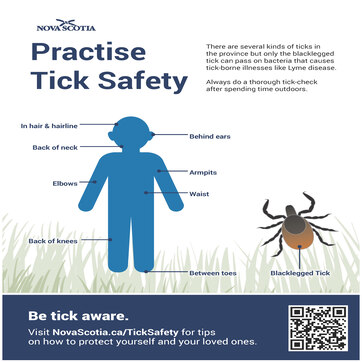
Enjoy the outdoors and be tick aware!
Summer and fall in Nova Scotia are wonderful seasons where people spend countless hours outdoors at the many beautiful beaches, trails, parks, and wooded areas across our province. As we take in these natural riches, we should also be mindful of the presence of ticks.
Here are some steps that you can take to protect yourself and your loved ones, especially in grassy, wooded, or shrub-covered areas:
- Apply insect repellents containing DEET or Icaridin to exposed skin and clothes. Follow directions on the package carefully. Infants under the age of six months should not use these products. Please visit Personal Insect Repellents - Canada.ca for specific instructions.
- Wear light colored, long-sleeved shirts and pants, closed-toed shoes, and tuck shirts into pants and pant legs into socks.
- Keep lawns mowed short.
- Put playground equipment in sunny, dry places away from wooded areas, yard edges, and trees.
- Check your whole body for ticks when possible (especially armpits, ears, knees, hair, groin) and take a bath or shower within two hours of coming indoors. This makes it easier to find ticks and washes away loose ones.
- Clothing is available that is treated with Permethrin (a chemical repellent) and can protect against ticks and mosquitoes for those 16 years of age and older. This clothing is not approved for those under 16 years of age in Canada.
What do I do if I find a tick on me/my child?
If you find a tick on your body, remove it as soon as possible to lessen the risks of infection. Here’s how to remove them safely:
- Carefully grasp the tick with tweezers as close to the skin as possible.
- Gently and slowly pull the tick straight out. Don’t jerk, twist or squeeze it.
- Clean and disinfect the site with soap and water, rubbing alcohol or hydrogen peroxide.
- To dispose of a tick, place it in a sealed plastic bag and either drown it in rubbing alcohol or freeze it for several days. Don’t crush ticks with exposed fingers. Once dead, throw the bagged tick in the garbage.
- Do NOT burn, squeeze, or coax a tick’s mouthparts from your skin using other methods.
How to keep your pets safe
While dogs and cats cannot directly transmit Lyme disease to people, a tick may enter your home on your pet's back and move on to bite a human. It is important to follow precautions for them too!
- Use veterinarian-recommended tick and flea preventatives for dogs and cats, especially during peak tick season (spring through fall). Not all products are safe for all species or ages—consult your vet for the most appropriate option.
- Check your pets for ticks daily after they’ve been outdoors—especially around the ears, neck, under the collar, and between the toes.
- Avoid letting pets roam through tall grasses or wooded areas where ticks are more likely to be found.
- Keep pet resting areas clean and inspect pet bedding regularly, especially if they spend time outdoors.
Download the new eTick application for free.
eTick.ca is a free service that can identify the type of tick usually within 24 hours. Though Lyme and other tick-borne diseases in Nova Scotia are transmitted by the blacklegged (deer) tick, not all black-legged ticks carry disease and not all blacklegged ticks have black legs.
For more information on tick-borne diseases, please visit: https://novascotia.ca/DHW/CDPC/lyme.asp
pdf To view the letter from Dr. Ryan Sommers of the Nova Scotia Health, click here.(123 KB)